
Starting a consulting business is a popular choice for many entrepreneurs due to its ease of starting and low-cost barrier. As someone who has started a consulting business, you are in the right place!
What Type of Consulting?
There are many types of consulting: business consulting, healthcare consulting, legal consulting, IT consulting, human resources consulting, financial consulting, security consulting, etc. The idea remains the same—you are sharing your expertise with others and advising them, whether they are businesses or individuals.
Registering Your Business
The first thing you want to do is register your business with your state and secure your business name. You can start as a sole proprietor immediately without registering your business. However, if you plan to operate as an LLC or under another corporate structure, you need to register your business. Consider whether you have a partner, need capital, want to protect your personal assets, or create a holding with subsidiaries. If you answer yes to any of these, you should consider forming a corporation.
Licenses
Typically, there is no license requirement for consultants since you are not expected to perform the job yourself; rather, you act as an advisor while your clients perform the work. However, certain licenses and certifications could enhance your business’s credibility and open doors to additional revenue streams. For example, as an IT or security consultant, obtaining specific security clearances might help you secure government contracts. Similarly, a Certified Public Accountant (CPA) who has passed the Uniform CPA Examination can offer services to publicly traded companies and handle their SEC filings. On the other hand, non-CPA accounting professionals are restricted from certain regulatory filings that require a CPA’s signature.
Business Insurance
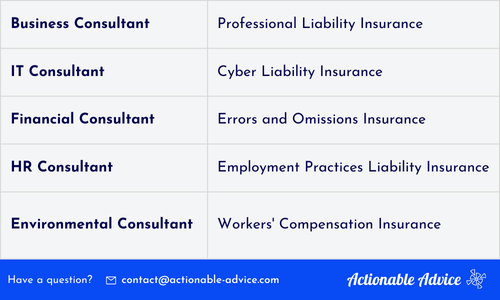
Regardless of the type of consulting you perform, I highly recommend obtaining relevant business insurance. Start with workers’ compensation insurance, as it’s required by law in most states in the U.S. This insurance covers medical expenses and lost wages for employees who are injured or become ill while on the job.
Here is a little cheat sheet for you. Below are some other types of insurance you may want to consider, depending on your specialty:
Business Model
When I started my consulting business, one of the biggest challenges was pricing. If you are transitioning from a similar role (working as a consultant and now starting your own), then it’s likely that you know the industry and have an idea in mind in terms of how to price your services. But if you are in the dark, here are some options:
- Project-based: This is a go-to model for advisor-type projects and temporary work. For example, a construction company that is not familiar with regulations may want to hire a consultant for their project.
- Hourly-rate: This is ideal for “on a needed-basis” work. If most of your clients engage for a short period of time (legal advice) and usually have a few questions and then move on, this might be something you should consider.
- Performance-based: Typically, businesses want to see results after working with a consultant. For example, a marketing consultant’s fee could be dependent on every extra lead/sale they bring in. However, this type of business model usually benefits the customer more than the consultant. So, run your numbers and make sure it’s a win-win.
- Retainer fee: Financial consultants and HR consultants might want to get their clients to this model. It’s like a subscription; your clients would pay a fee every month/year based on recurring work. The other scenario could be other businesses outsourcing some of their work as they don’t have the bandwidth—in that case, your consulting business could act as their extended arm in return for a fixed fee.
Although there are several different business models out there, sometimes it’s tough to be creative in an established industry, and you may need to price your services based on your competition and industry expectations. For example, it is uncommon for a healthcare consultant to price their services based on performance (health outcome). So, in that case, you may need to go with a pricing model that is the norm in your industry.
Building an Audience and Marketing
One of the most important and time-consuming parts of starting a consulting business is building an audience. Ideally, go backwards. In other words, start your business when you think you have an audience. Sometimes you know you have an audience, and sometimes you are not aware of that! If you have clients, a network, or other connections that might be interested in your consulting business, then you have an audience. But if you are just starting out and don’t have many leads, it will take some time to build an audience. So, hang in there and be patient! I would also suggest keeping your full-time job or having a part-time job until you generate a stable income.
There are several ways to build an audience. But before getting too excited, do your homework and know your target market, understand their buying process and behavior, then with that knowledge, focus your efforts where your return on investment might be the highest. For example, for a financial consultant, direct mail might not be the best marketing channel as trust and building personal relationships are key. However, for an environmental consultant, it would make sense to send postcards to businesses in an industrial park/site.
Networking
Networking can be online and offline. Offline networking is pretty straightforward: go to industry events, conferences, and networking events to connect with others who might benefit from your services. Build marketing collateral and give your elevator speech with a smile and a sparkle. Be authentic and tell your story in less than 2 minutes while focusing on the benefits of your services.
Online Marketing
Online marketing is typically through social media, especially on LinkedIn if you have a B2B consulting business. Research your connections on LinkedIn and send direct messages (InMails), and ask for introductions from your connections. For B2C consultants, Facebook and Instagram are the way to go. If you want to learn more about building an audience through social media, check out this course! Trust me, you won’t regret it.
Ads
For those who are starting without many leads, ads could help you to take off your business. You can run ads on social media or search results. For example, let’s say you are an HR consultant focusing on the transportation industry, then you can run ads for keywords such as “truck driver jobs,” “heavy truck driver,” “entry-level truck driver.” The idea is to get them on your website (btw, you need a website) and then collect their contact information and add them to your CRM.
Ultimately, your marketing strategy depends on your industry, target market, and overall business strategy. But the examples above should give you some ideas, and feel free to tailor your strategy to your consulting business. I would be happy to work with you on building a successful marketing strategy and save you from that headache! Just shoot me an email to connect: contact@actionable-advice.com. You can also get a free marketing plan template here.
Content Marketing
This is more like a long game. But you have to start somewhere. Content marketing means creating content for your audience and positioning yourself as a thought leader. You can share content on your website, social media, via events, seminars, etc. Content marketing can help your business to build trust and, most importantly, drive your customer acquisition cost down as you continue creating content. It’s likely that you won’t see returns in the beginning, but trust me, after a certain point, you will be swamped with leads. That said, you have to carefully build your content strategy as you will be competing with other content creators. For example, you can’t just start posting blogs you like. You need to research keywords that are low competition and high volume. Again, this is another thing I can help you with. One of the blogs that I manage grew 605% in 3 years and now generates hundreds of leads every month. But it takes a lot of work. So, there needs to be a strategy behind your content marketing. But content marketing pays off!
Ultimately, your marketing strategy depends on your industry, target market, and overall business strategy. But the examples above should give you some ideas, and feel free to tailor your strategy to your consulting business. I would be happy to work with you on building a successful marketing strategy and save you from that headache! Just shoot me an email to connect: contact@actionable-advice.com. You can also get a free marketing plan template here.
Let’s Make It Happen
I hope this post has gotten you a step closer to starting your consulting business. Here you can get your checklist to make sure you are not missing anything! Starting a consulting business could help you generate additional income and even become an automated money-maker. But it takes time and a lot of trial and error. I’m always here to help you navigate all the challenges and get you there faster without wasting your budget. Reach out to schedule a quick call: contact@actionable-advice.com.
 Actionable advice
Leave a comment