
Starting a Business All In One for Dummies

This Starting a Business all in one for Dummies article will fully prepare you to start your business. Starting a business might sound complicated and overwhelming. But I simplify it for you in this post. This is all you need, dummy! Let’s dive right in.
Table of Contents
- The Fundamentals
- Registering Your Business
- Can I Start an LLC Without a Business?
- Do I Need an LLC to Start a Business?
- Should I Get an LLC Before Starting a Business?
- How Long Does It Take to Start a Business?
- Business Insurance
- Business Licenses
- What Licenses Are Needed to Start a Landscaping Business?
- Average Cost to Start a Business
- How to Be a Successful Entrepreneur
- Bonus!
TL;DR
Here is a checklist for you “super-busy guys.” But promise you will still skim through this Dummy’s Guide to Starting a Business, right?
The Fundamentals
I will keep it pretty simple as this post is all about starting a business all in one for dummies! To start a business, you need a business idea (duh!). Next, you want to research your market and understand your industry, local area, pricing, target market, and pricing. Also, think about who your suppliers might be and what equipment you might need. Do you need office space?
Let’s assume you have all that figured out. The next thing you want to do is to register your business. But before moving on to that, you need to decide on your business structure.
Registering Your Business
Two of the most popular business structures are Sole Proprietorships and LLCs. My rule of thumb is if you have a proven and tested idea and are serious about it, go for an LLC. However, if you want to start something on the side and just want to test the waters, opt for a Sole Proprietorship (you don’t need to register your business; you can start right away with your SSN). Another important piece of information is whether you want to get a loan or not. If you need outside capital/investment, then you need a more formal structure than a Sole Proprietorship. If you want to register an LLC, S-corp, or C-corp, go to your state department’s website and start the registration process. That’s all you need for now. Let’s move on!
Can I Start an LLC Without a Business?
The answer is yes! But let’s be honest, that’s a weird question. Why would you start an LLC without a business? But no judgment! Technically, you can start an LLC without a business. But you need to know the type of business you will start because most business registration systems will ask for your industry. You can pick a random industry and try to change it after you know your industry, but still, it’s not the ideal approach
Do I Need an LLC to Start a Business?
No, you don’t necessarily need an LLC to start a business. An LLC is one of the business structures along with Sole Proprietorship, S-Corp, C-Corp, etc. You can start a sole proprietorship with your SSN, and there is no registration process for that. You can just start selling. However, keep in mind that although sole proprietorship is the easiest form of business to start, there are some disadvantages to it; most importantly, your debtors can go after your personal assets (home, car, savings, etc.).
Should I Get an LLC Before Starting a Business?
Ideally, register your business before starting it. As I mentioned above, it doesn’t have to be an LLC. But if you have decided that an LLC is the right structure for your business, then register an LLC before doing anything else. That way, you can start using your business name and open a bank account to keep your personal and business finances separate.
How Long Does It Take to Start a Business?
It takes 5-10 minutes to start a business depending on how fast you go on your state department website and complete registration. If you want to start a sole proprietorship, you don’t even need to register your business; you can start whenever you like! But it would be smart to take a couple of steps before starting your business. Make sure to look at this free starting a small business checklist before taking any action!
What’s Next?
The next thing you want to do is to open a bank account. Make sure you have a separate account from your personal finances. Believe me, you don’t want the IRS to knock on your door! Go to your favorite bank, credit union, or online platform and get a business bank account before purchasing anything or invoicing your customers.
Get Business Insurance
Next is business insurance. Most states require workers’ compensation insurance if you will hire employees. Go to Reddit, ask around, and start shopping to see what’s best for your budget. While workers’ compensation insurance is a must for any business with employees, there are other types of insurance you may want to consider depending on your industry. For example, you may want to get cyber insurance if you plan on storing confidential customer information.
Business Licenses
What Licenses Are Needed to Start a Business?
Well, I’ll have to use my “it depends” card for this one. For most businesses, you don’t need a license, but if you are starting a business in food and beverage, healthcare, waste management, childcare, or real estate, then you might need a license.
What Licenses Are Needed to Start a Landscaping Business?
For example, for a landscaping business, you might need a landscape contractor license, commercial applicator license (if you will apply pesticides), stormwater permit depending on your state, and an irrigation license. Some of these licenses may require training/certification.
On the other hand, if you want to start a consulting business, you can start your business without any license.
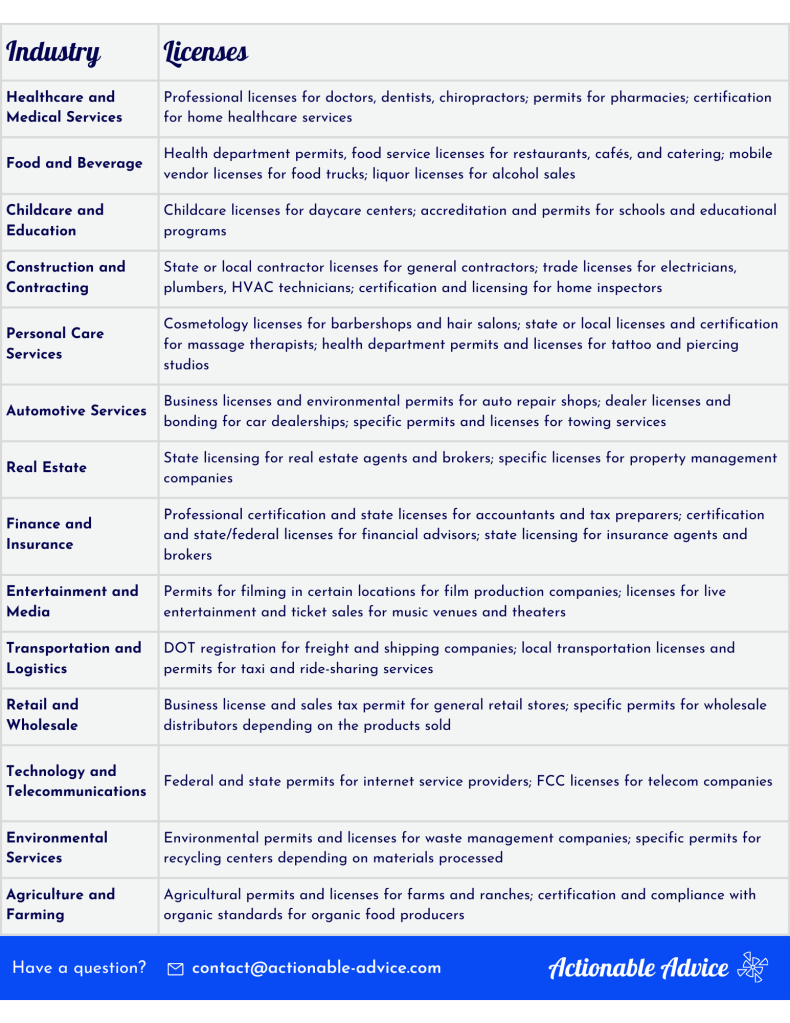
Here is a complete list of what licenses are needed for each industry. However, license requirements might vary depending on your state and city.
What else?
After following the steps above, you are legally covered and can unlock the next level! The next steps are mostly operational and optional. Here are some of the things you may want to work on:
- Bookkeeping: You can either work with an accountant, get software like QuickBooks, or use an Excel spreadsheet. But you need to do one of these!
- Hiring: Start building your team and think about everybody’s role. Create job descriptions if needed or ask around.
- Business Plan and Financial Projections: A business plan is a written document that outlines pretty much everything we discussed here plus your marketing strategy, organizational structure, and financial projections. Although it’s not mandatory, it’d be very helpful to have a business plan which would be your guide and help you keep things organized. You can get your free business plan template here.
- Loan: Most businesses need additional capital to start and grow. To get a loan, you need a business plan, bank account, financial projections, and a healthy credit score. Here is a detailed post on how to get a business loan.
- Website: I hope you have thought about this and this is not a shocker! At least have a simple and functioning website and optimize it for local search results (especially if it’s a brick-and-mortar business). Here is a guide on how to start a business website.
- Social Media: Remember we briefly talked about market research? This is where it comes in handy. Based on your research and background, pick social media channels that you want to be on and secure social media handles for your business.
- Software & Tools: You will need stuff like an email platform, payroll system, CRM, or other tools that might be useful for your business.
- Equipment & Inventory: Before starting to sell, you need to order raw or finished products unless it’s a service business. You don’t want to have a backlog before opening your doors
Average Cost to Start a Business
Although the average cost to start a business depends on what business you start, I would hate giving you a typical consultant answer: “it depends.” So, let’s get our hands dirty and make some assumptions to get you a number! For starters, there are some expenses regardless of the industry/type of business.
Business Registration Fee
As mentioned above, if you plan on starting a sole proprietorship, you don’t have to register your business. You can start a business right away using your SSN. However, if you are concerned about protecting your personal assets from debtors and want to have a more formal business structure such as an LLC, then you must register your business within your state.
The average LLC registration fee is between $50 and $800 (if you are lucky enough to start a business in California) in the U.S.
Insurance
Second, there is the insurance cost. As I mentioned, most businesses are required to get workers’ compensation insurance. The average cost is $1.25 per $100 of payroll. Let’s say you are paying $250,000 on wages (annually); then the workers’ compensation insurance would be around $3,125 ([$250,000/$100]*$1.25) for a medium-risk industry.
Other
We have talked about the inevitable expenses. Other expenses include:
- Accounting
- Equipment
- Gas
- Inventory & Supplies
- Licenses
- Loan & Interest
- Marketing and Advertising
- Payroll
- Rent
- Taxes
- Utilities
For example, the annual average cost to start a cleaning business in New York would be around $ based on the assumptions of $50,000 equity and a $50,000 loan with 9 employees (3 teams with 3 cleaning personnel) plus the owner and no office space. Let’s look at the breakdown with some moderate numbers:
- Accounting: $5,000
- Equipment: $7,000 startup expenses (3 sets of cleaning equipment at $2,000 each and a laptop for $1,000)
- Car: $15,000
- Gas: $20,000 (150 miles/day)
- Inventory & Supplies: plus $24,000 annual expenses including cleaning products, paper towels, trash bags, and maintenance
- Registration & Licenses: $200
- Loan & Interest: $11,000 ($50,000 loan, 6% interest rate, 60 months)
- Marketing and Advertising: $60,000 ($5,000 on ads/month)
- Payroll: $280,000 (working at full capacity, 40 hours/week, 52 weeks)
- Insurance: $3,500 (only workers’ compensation insurance)
- Taxes: $100,000 (based on $468,000 revenue, $200/client, 3 teams, 9 clients/day, 25% income tax)
- Software & Tools: $15,000 (including a cleaning management software)
- Miscellaneous: $10,000
Based on these assumptions, total annual operating costs come to $437,000 and startup expenses are around $30,000 (car, software, equipment, registration, advertising, and insurance) based on very moderate assumptions. As you may have noticed, the first-year net income is just around $30,000, which is typical for a new business. That said, you should be prepared not to make any profit for the first couple of years. Remember, these are just ballpark numbers, but this should give you a good idea of what the average cost to start a cleaning business would be. You can play with the numbers and expense items based on your state, industry, equity, etc.
How to Be a Successful Entrepreneur
One thing I want to emphasize is that starting a business is one thing, and making it a successful business is another. To have a successful business, it takes time. So, my advice is not to overthink. Don’t get me wrong; make sure you do your research and have a solid business plan before rolling up your sleeves. But my point is, don’t wait for the perfect moment or scenario to start your business. Nothing will ever be perfect. You don’t have to be great to start, but you have to start to be great. The sooner you start, the sooner you will start making money. You will find a lot of people giving you advice online and offline, trying to break your motivation, stopping you from what you are passionate about, and pushing you in other directions. But successful people follow their passion and always find a way to make things work. Alright! This is starting a business all in one for dummies!
Bonus: Marketing Course
For those who are serious about getting into business, here is one of my flagship courses on small business marketing. This course will definitely get you closer to opening your doors and, most importantly, start selling! Here is a little encouragement for you: use the code “STARTING” to get 20% OFF. Don’t let your business wait. Start your course today!

 Actionable advice
Leave a comment